Munro DNA Project
Overview
The Munro DNA project was initiated in late 2001 by North Carolina Monroe/Munroe researchers with the goal that Family Tree DNA would become a repository of Munro DNA worldwide. Participants include bona fide representatives of the following lines:
- Certain Foulis-Munro chiefs and cadet branches
- President James Monroe
- Banished prisoners of war after the Battle of Worcester in 1651: William Monroe of Lexington, MA, whose descendants were of American Revolutionary War fame and John Munro of Bristol, RI, ancestor of Marilyn Monroe
- James Munro, Premier of Victoria
- Lochfyneside Munros
Background
Researchers whose ancestors emigrated from the Loch Fyne area in Argyll to North Carolina formed the Munro Project. It was always the desire that the project would move forward from being a localized group to participation by Munros worldwide.
Goals
The goals of the Munro DNA project are as follows:
- to assist researchers trying to break through a brick wall in their research.
- to correct inaccuracies in family history.*
- to increase Scottish participation in the project.
Administrators: |
Margaret Bardin |
|
Mark A. Monroe |
* Alexander Mackenzie published the History of the Munros of Foulis in 1898. It stated that the Lexington Monroes were of the Foulis-Munro line. DNA research has disproven this assertion. The groupings of the different Y-DNA participants can be viewed from this link.
The Origin of the Munros of Foulis
Tradition has it that the founder of Clan Munro, one Donald, came from Ireland in 1025 CE to help King Malcolm II repel Viking invaders. He was rewarded with land in Easter Ross, called after him Ferindonald. Donald was said to belong to the O’Kane family, followers of the powerful O’Neills of Ulster.
Despite a tradition which lists all Donald’s successors as chief over the next centuries, the earliest Munro chief to be recorded in documents of his own time is Robert, so-called 8th baron or laird of Foulis, who died in 1369 CE.
Studies of the DNA of the Y or male chromosome allow investigation of the deep ancestry of the Munro of Foulis male line to confirm or refute this tradition. From time to time a mutation occurs in the Y chromosome; these rarely have any effect on it, but they are is passed from father to son through all male descendants. Men bearing a particular mutation must have a common male ancestor in whom it first occurred. Mutations occur randomly over time, but the average rate of an accumulating series of mutations permits the branching of the male tree to be followed over time.
Several documented male line descendants of Robert’s son Hugh, 9th baron of Foulis, share a group of unique Y chromosome markers, such as a mutation called Y12073, which are not found in other families. Because Hugh’s descendants by two different sons share these markers, Hugh himself must have belonged to this line.
This Munro of Foulis male line is part of a branch or Haplogroup of the Y chromosome tree called I2a, which separated from other male lines in the Middle East about 20,000 years ago. Its bearers are now commonest in the Balkans, but some of this group made their way to the British Isles about 7000 years ago. At least 1750 years ago, a new mutation called PF4135 arose in a man whose male descendants are now most commonly found in Southwest Ireland. These include the large O’Driscoll family of West Cork, but the Munros of Foulis also carry PF4135 and so must have a common male ancestor with the O’Driscolls and other Irish families who bear it.
A series of later Y chromosome mutations are shared by the Munros with other men, some of whom still live in Southwest Ireland, but the most recent common male ancestor with any known non-Munro tested lived at least 1250 years ago. This finding is consistent with the founder of the clan having come from Ireland, and leaves plenty of time for his paternal ancestors to have migrated from County Cork to Ulster, so there may be a basis in fact for the traditional origin.
As it is rare to have sons in every generation indefinitely, most male lines throughout history eventually become extinct, so it is not surprising that even if there were earlier chiefs of this line, they have not left male descendants other than Hugh. Moreover, Hugh was born about 1340, the period of the Black Death, which may also account for the absence of other early branches of the line. However Hugh’s progeny have subsequently prospered, with important cadet branches surviving to the present day. We know for example that Hugh’s 16th C. descendant Robert the 14th baron carried a later mutation, A11984, as it is found in male descendants of the 19th C. chief Sir
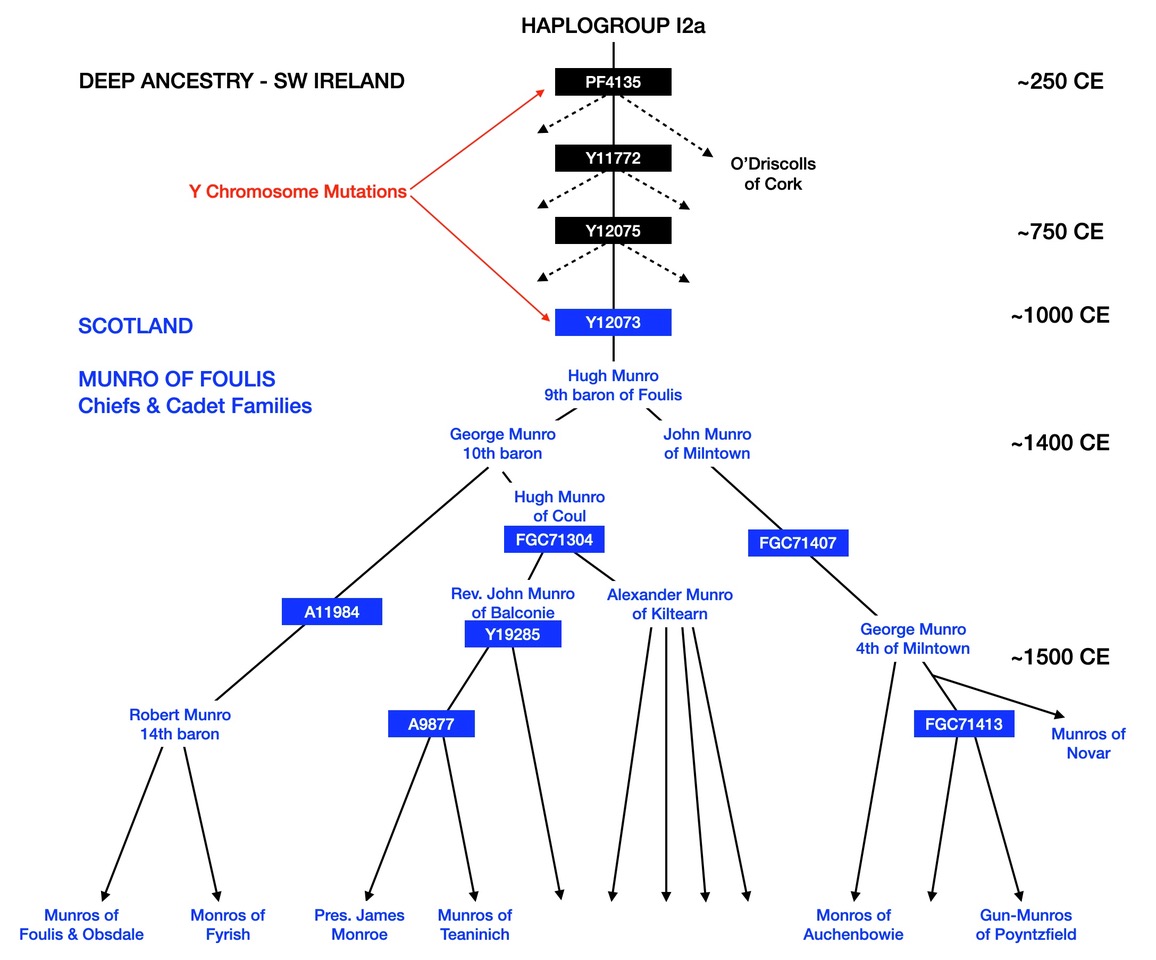
A series of later Y chromosome mutations are shared by the Munros with other men, some of whom still live in Southwest Ireland, but the most recent common male ancestor with any known non-Munro tested lived at least 1250 years ago. This finding is consistent with the founder of the clan having come from Ireland, and leaves plenty of time for his paternal ancestors to have migrated from County Cork to Ulster, so there may be a basis in fact for the traditional origin.
As it is rare to have sons in every generation indefinitely, most male lines throughout history eventually become extinct, so it is not surprising that even if there were earlier chiefs of this line, they have not left male descendants other than Hugh. Moreover, Hugh was born about 1340, the period of the Black Death, which may also account for the absence of other early branches of the line. However Hugh’s progeny have subsequently prospered, with important cadet branches surviving to the present day. We know for example that Hugh’s 16th C. descendant Robert the 14th baron carried a later mutation, A11984, as it is found in male descendants of the 19th C. chief Sir Charles Munro, 9th baronet, and also in the Monro of Fyrish line descended from Robert’s younger son Hector.
Hugh’s son George, 10th baron of Foulis, had a son Hugh of Coul, whose first son was Rev. John Munro of Balconie. Two unique genetic markers, Y19285 and A9877, prove that the latter was the patrilineal ancestor of US President James Monroe, as both are shared by the well-documented Scottish Munro cadet family of Teaninich. Hugh of Coul’s younger son Alexander of Kiltearn also has many male line descendants in the present day. The 10th baron’s younger brother was John Munro of Milntown and his male descendants include the famous medical family, the Monros of Auchenbowie, as well as the Munros of Novar, and the Gun-Munros of Poyntzfield.
DNA testing has shown that the Y chromosome of Hugh Munro, 9th baron of Foulis, has spread around the world. Extrapolating from a genetic population survey suggests that today there are over 10,000 living men of Haplogroup I2a-Y12073, Hugh’s male line descendants, in the USA alone.
It is easy to identify men as descendants of the Munro of Foulis male line by testing for Y12073 and other markers, and if they are present, usually possible to assign them to one or other of the cadet branches mentioned above. However, like all clans the Munros are made up of many different male lines, indeed over 75% of present day men called Munro or Monroe etc. do not belong to the Munro of Foulis male line. Conversely, men of other names around the world have discovered that they too are descended in the male line from the earliest known chiefs of Clan Munro of Foulis.